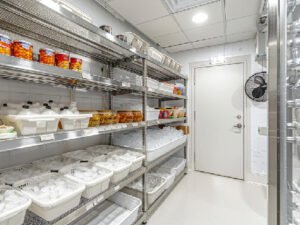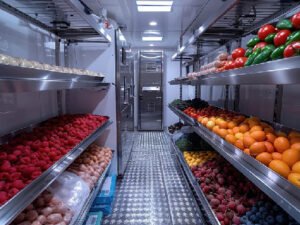


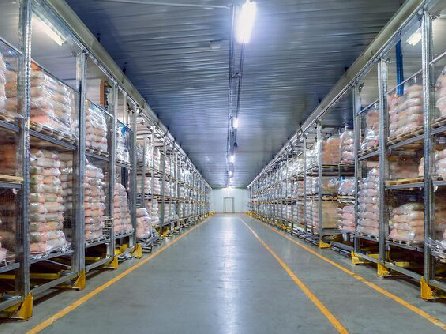
Cold Storage Warehouse
A cold storage warehouse is a specialized facility designed to preserve temperature-sensitive products by maintaining controlled low-temperature environments. Unlike standard warehouses that focus on space and logistics, cold storage warehouses are engineered around temperature, humidity, and air quality control to ensure product safety and longevity.
Key Features
- Temperature Control: Maintains chilled (0 °C to +4 °C) or frozen (−18 °C to −20 °C) conditions, depending on product needs.
- Insulated Construction: Uses PUF/PIR panels and vapor barriers to minimize heat transfer.
- Refrigeration Systems: Equipped with compressors, condensers, evaporators, and fans for uniform cooling.
- Humidity Regulation: Prevents dehydration of fresh produce or frost damage to frozen goods.
- Monitoring & Automation: Sensors and IoT systems track temperature, humidity, and energy efficiency.
Applications:
- Food Industry: Meat, seafood, dairy, fruits, vegetables, beverages, bakery items.
- Pharmaceuticals: Vaccines, biologics, and drugs requiring strict cold chain compliance.
- Chemicals & Biotech: Sensitive materials needing stable environments.
- Logistics & Export: Distribution hubs for perishable goods across long distances.
Advantages:
- Extends shelf life and reduces spoilage.
- Ensures compliance with food safety and pharma regulations.
- Supports diverse supply chains and seasonal storage needs.
- Provides scalability with multi-commodity chambers.
Comparison with Other Cold Rooms
- Walk-in Chiller Room | 0 °C to +4 °C | Fresh produce, dairy, beverages |
- Walk-in Freezer Room | −18 °C to −20 °C | Meat, seafood, ice cream |
- Blast Freezer Room | −30 °C to −40 °C | Rapid freezing for quality preservation |
- Cold Storage Warehouse | Flexible zones | Large-scale, multi-commodity storage |